Varnuqel
Nexus Framework
Nexus Framework
Couldn't load pickup availability
1. Problem Statement
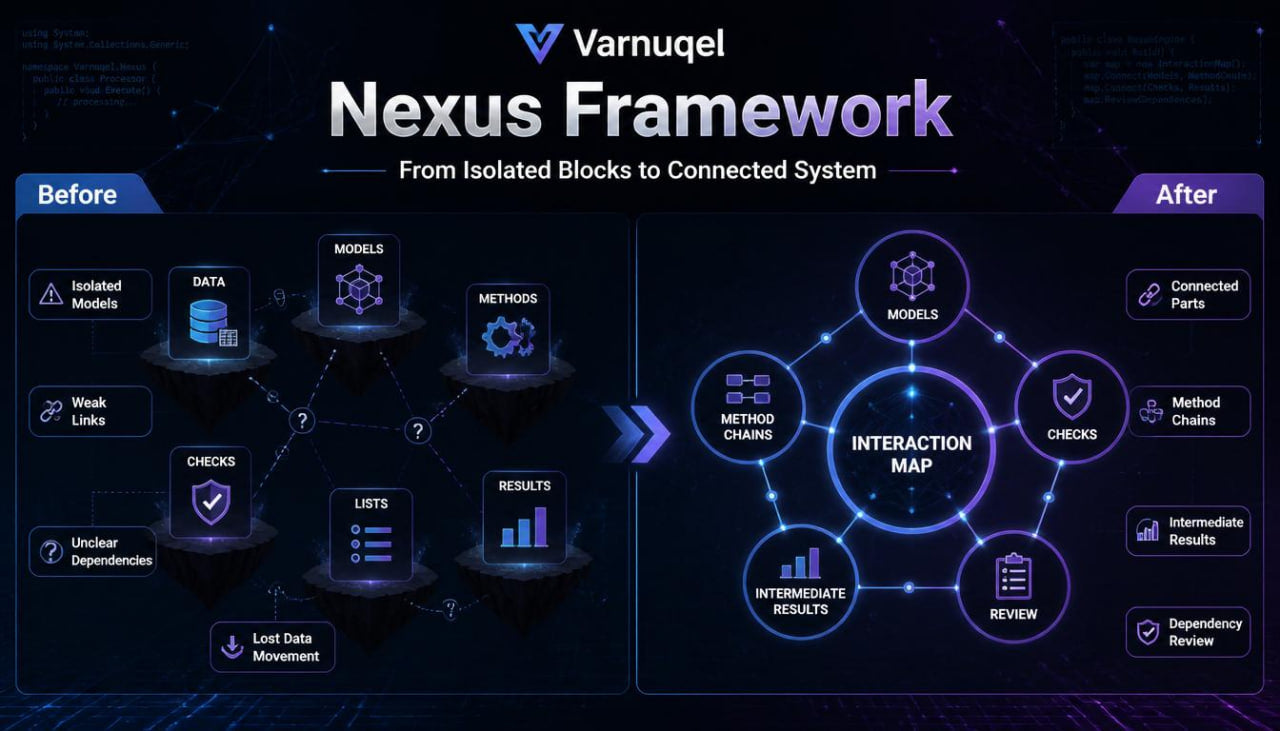
At the ninth stage, the learner already knows many separate topics, but difficulty appears when these topics need to be joined into one connected learning task. A class may have a clear role, a method may perform a clear action, and a list may be handled in sequence, yet the full structure can still become hard to read. The learner may lose the main logic when one scenario includes several data sources, several checks, and several intermediate results. It can also be difficult to understand which parts should stay separate and which parts can be joined without losing meaning. That is why this stage needs materials that teach learners to see links between blocks, not only separate technical actions.
2. Solution
Nexus Framework is built as a learning route for connected scenarios of medium and higher complexity. The materials help the learner create an interaction map: which data enters the scenario, which classes describe it, which methods perform separate actions, which checks affect the later order, and where the output is formed. Each module presents the topic through explanation, example, exercise, analysis, and a short written conclusion. The learner studies not only how to write a fragment, but also how to explain why the parts are connected in a certain way. This tier prepares the learner for the closing Path Framework, where the learning task becomes a longer route with full structure and final review.
3. What’s Inside
Nexus Framework includes detailed materials for connecting several learning directions in .NET Framework. If Luma Framework taught how to build a broader example from several parts, Nexus Framework moves attention to the interaction between those parts. Here, it is important not only to have classes, methods, conditions, and lists, but also to understand how they influence one another.
The first module is dedicated to the interaction map. The learner begins not with code, but with a description of links: which data is needed, which objects represent it, which actions should happen, and which parts depend on one another. The materials show how to build a simple scenario scheme before working with fragments. In the exercise, the learner receives a task description and divides it into blocks: data, checks, processing, intermediate output, and final conclusion.
The second module reviews several learning models in one scenario. The learner works with examples where there is not one object, but several connected entities: a record, a category, a check result, a short state description, or an item from a set. The materials explain how not to mix these entities inside one class and how to define what each model handles. In the exercises, the learner finds classes that are too broad, divides them into clearer parts, and describes the role of each one.
The third module is dedicated to methods that work in a chain. The learner studies scenarios where one method prepares data, the second performs a check, the third handles processing, the fourth forms an intermediate output, and the fifth prepares the final explanation. The main focus is not the number of methods, but the links between them. The learner traces which values pass between parts, where they change, and how to keep the logic readable during the transition.
The fourth module focuses on checks that affect different parts of the scenario. At this stage, one check may change the later route: part of the data may be selected, another part may be skipped, and a third part may be passed into a separate method. The materials explain how to place checks so they are not repeated without need and do not break the full order. In the exercises, the learner rebuilds scenarios where checks are poorly placed or repeated in several places.
The fifth module is dedicated to working with data sets that pass through several stages. The learner reviews lists of learning objects that are first checked, then grouped, then processed, and finally used for a summary. The materials show how to describe each stage separately and how not to mix selection, counting, and preparation of a text explanation. Module tasks help trace the path of data from the starting set to the final review.
The sixth module introduces intermediate outputs. In broader scenarios, the final result often does not appear at once: smaller conclusions appear first and are later used in other parts. The learner studies how to create intermediate values, give them clear names, and explain their role. The materials show when an intermediate output helps reading and when it only adds an extra part.
The seventh module is dedicated to dependency analysis. The learner receives examples where one part depends too strongly on another, so a change in a small fragment affects the full scenario. The materials explain how to notice such places and how to rebuild the example so parts have clearer boundaries. In the exercises, the learner identifies which methods or classes know too much about other parts and suggests a calmer division.
The eighth module reviews written technical analysis. After working with a broader scenario, the learner explains not only what was done, but also why the structure was built that way. The review includes a task description, list of parts, data movement, role of checks, place of intermediate outputs, and final conclusion. This format helps check whether the scenario is truly clear or whether some places need further clarification.
The ninth module completes the tier with a final scenario. The learner receives a learning task where several models, methods, checks, a list of objects, and a final review need to be connected. The work moves through stages: task analysis, interaction map, model building, method creation, check placement, data set handling, intermediate conclusions, and final written review. This module prepares the learner for Path Framework, where the full route becomes even more sequential and complete.
4. Who Is This For?
Nexus Framework is for learners who can already work with broader .NET Framework examples and want to better understand interaction between several parts. This tier is for those who know classes, methods, conditions, objects, and lists, but want to see how these elements work inside a shared scenario.
The tier is useful for learners who want to plan dependencies between parts before writing code. If the learner wants to understand how data moves, how intermediate outputs affect the final result, and how to divide the roles of classes and methods, Nexus Framework provides sequential materials for that. It is also a preparation stage before the closing tier, where all earlier topics are gathered into a longer learning route.
5. What You’ll Learn
- Create an interaction map for a broader scenario.
- Separate data, checks, processing, and outputs.
- Work with several learning models.
- Define the role of each class in a shared structure.
- Build method chains without losing logic.
- Trace value movement between parts.
- Place checks in fitting locations.
- Work with lists through several stages.
- Create intermediate outputs for broader exercises.
- Analyze dependencies between classes and methods.
- Rebuild scenarios with weak links.
- Write a structure review after completing a task.
6. 30-Day Terms
For the Nexus Framework tier, there is a 30-day period during which the learner may submit a request concerning the order according to the Varnuqel store terms. Details depend on checkout conditions, material type, and the terms listed in the store policy section. This section is presented as a neutral explanation of the process, without pressure or exaggerated claims. Before checkout, learners should review the store terms carefully to understand how such requests are handled. For questions about the tier, material structure, or learning topics, the learner can write to the Varnuqel team through the contact page.
Self-paced learning overview
- 📁 Digital file available after purchase
- ♾️ Long-term availability
- 🔐 Secure checkout
- 🗓️ Content updated in 2026
Are the courses suitable for beginners?
Are the courses suitable for beginners?
Yes, the materials are built step by step: from basic concepts to practical tasks. Learners can move at their own pace and return to modules for review.
What is included in the learning materials?
What is included in the learning materials?
Each plan includes lessons, explanations, examples, exercises, and structured modules. The content depends on the plan depth and topic range.
Do I need previous experience with .NET Framework?
Do I need previous experience with .NET Framework?
Previous experience is not required for the first plans. More advanced plans are better suited for learners who already understand basic code logic, classes, methods, and project structure.
Share