Varnuqel
Path Framework
Path Framework
Couldn't load pickup availability
1. Problem Statement
At the tenth stage, the learner already knows many topics, but the challenge is to gather them into a sequential learning task without losing logic. Short exercises may be clear, and separate scenarios may read well, but a longer route requires a different level of organization. One learning example may include several models, method chains, several checks, data set handling, and a written conclusion. Without a plan created first, parts can mix, repeat, or depend on one another too tightly. This is why the learner needs a tier that supports the full route: from task description to review of the completed structure.
2. Solution
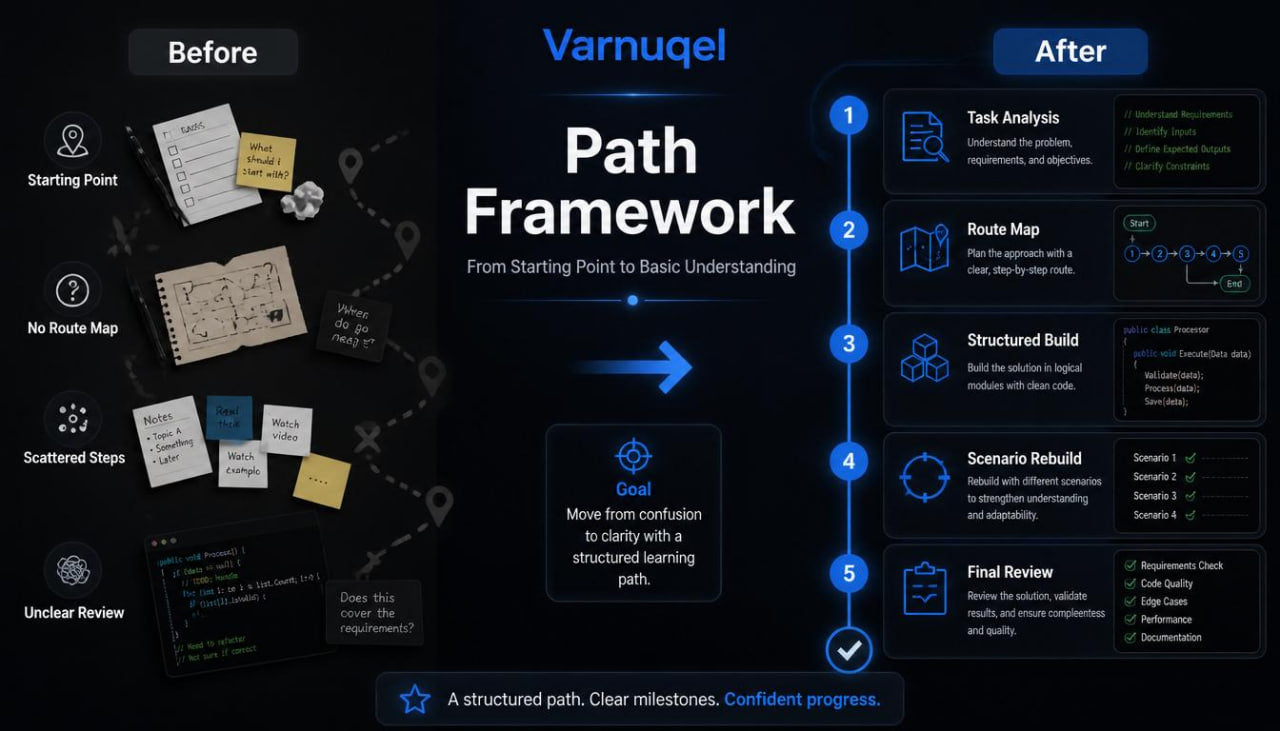
Path Framework is built as a complete learning route where each stage has its place and clear role. The learner begins with task analysis, creates a map of parts, defines models, places methods, adds checks, works with data sets, and prepares a final review. The materials do not present the topic as separate exercises only; they show how different parts gradually form one sequential structure. Each module includes explanation, example, practical task, self-check questions, and a short written conclusion. This format helps the learner see not only separate actions, but the full path of working with a learning example.
3. What’s Inside
Path Framework includes a detailed series of materials that bring earlier Varnuqel topics into a longer practical route. If Nexus Framework focused on links between parts, Path Framework shows how those links work inside a full learning sequence. Here, the goal is not only to create classes, methods, or checks, but to understand how they appear in the right order and support the full logic.
The first module is dedicated to learning task analysis. The learner receives a scenario description and studies how to divide it into meaningful parts: what data is present at the start, which actions need to happen, which checks may affect the route, and what output should be prepared. The materials explain why moving directly into code is not helpful here. First, the learner needs to understand the task, mark its boundaries, and remove extra assumptions.
The second module introduces the route map. The learner creates a scheme for future work: input data, models, methods, checks, processing, intermediate outputs, and final review. In the exercises, the learner compares several maps of one scenario and decides which one reads with clearer sequence. The learner also studies how to explain why a certain part stands in that exact place.
The third module is dedicated to data models. The learner works with several learning models that describe different parts of the scenario: main record, category, state, check result, and short output. The materials show how not to mix different roles inside one class and how to give each model a clear purpose. In the tasks, the learner reviews overly broad models, divides them, and explains the new structure.
The fourth module reviews methods as route stages. The learner studies how a method can handle one specific action: prepare data, check a value, process a list, create an intermediate output, or form the final explanation. The materials show how methods can work in a chain without mixing roles. In the exercises, the learner traces what each method receives, what it returns, and how its output affects the next stage.
The fifth module is dedicated to checks inside a longer scenario. The learner reviews how one check can change the later path, while several checks can work at different levels of the structure. The materials explain how to avoid repetition, how not to place conditions chaotically, and how to describe their role in written review. Module tasks help rebuild fragments where checks make reading harder or repeat one another.
The sixth module introduces data sets inside the full route. The learner works with lists of learning objects that pass through several stages: preparation, checking, selection, grouping, counting, and final presentation. The focus is on giving each stage a separate role. The learner describes how data moves from the starting set to the final conclusion.
The seventh module is dedicated to intermediate outputs. In longer scenarios, it is often useful to keep not only the final result, but also smaller values that explain the movement of logic. The materials show when such an output helps reading and when it is better removed. The learner studies how to give intermediate values clear names and describe their role in the route.
The eighth module reviews rebuilding a completed scenario. The learner receives an example that contains valid learning ideas but has weak organization: long methods, unclear models, repeated checks, and confusing data movement. The task is to rebuild the scenario gradually while keeping its meaning. After each step, the learner writes a short explanation: what changed, why the structure became clearer, and which parts now have better boundaries.
The ninth module is dedicated to written review. The learner studies how to describe not only code, but also the logic of construction: where the task began, which parts were created, how they connect, where checks happen, how data moves, which intermediate outputs appear, and how the final conclusion is formed. This review helps reveal weak points that are not always visible during fragment writing.
The tenth module completes the tier with a closing learning task. The learner receives a scenario that must be taken from first reading to full review: task analysis, route map, models, methods, checks, lists, intermediate outputs, rebuilding, and final written conclusion. This module gathers earlier topics into one sequential path and helps the learner see how Varnuqel materials form a complete learning system.
4. Who Is This For?
Path Framework is for learners who have completed earlier Varnuqel tiers or have enough practice with .NET Framework learning examples. This tier is for those who want to work not only with separate fragments, but with a longer route where each part has meaning.
The tier is useful for learners who want to plan work before writing code, divide roles between classes and methods, explain checks, work with data sets, and create written review after completing an exercise. Path Framework also fits learners who want to review earlier tier topics through one connected learning sequence.
5. What You’ll Learn
- Analyze a longer learning scenario before writing code.
- Create a route map for a full exercise.
- Divide roles between models, methods, and checks.
- Work with several learning models in one scenario.
- Build method chains with clear order.
- Trace data movement through several stages.
- Place checks without extra repetition.
- Handle lists of learning objects.
- Create intermediate outputs to explain logic.
- Rebuild scenarios with weak organization.
- Write a meaningful review after completing a task.
- Combine earlier tier topics into one learning path.
6. 30-Day Terms
For the Path Framework tier, there is a 30-day period during which the learner may submit a request concerning the order according to the Varnuqel store terms. Details depend on checkout conditions, material type, and the terms listed in the store policy section. This section is presented as a neutral explanation of the process, without pressure or exaggerated claims. Before checkout, learners should review the store terms carefully to understand how such requests are handled. For questions about the tier, material structure, or learning topics, the learner can write to the Varnuqel team through the contact page.
Self-paced learning overview
- 📁 Digital file available after purchase
- ♾️ Long-term availability
- 🔐 Secure checkout
- 🗓️ Content updated in 2026
Are the courses suitable for beginners?
Are the courses suitable for beginners?
Yes, the materials are built step by step: from basic concepts to practical tasks. Learners can move at their own pace and return to modules for review.
What is included in the learning materials?
What is included in the learning materials?
Each plan includes lessons, explanations, examples, exercises, and structured modules. The content depends on the plan depth and topic range.
Do I need previous experience with .NET Framework?
Do I need previous experience with .NET Framework?
Previous experience is not required for the first plans. More advanced plans are better suited for learners who already understand basic code logic, classes, methods, and project structure.
Share